Carlos's Lawyer was stunned because most Japanese people can't escape that way.
Carlos Ghosn lawyer stunned as Nissan ex-boss flees Japan for Lebanon
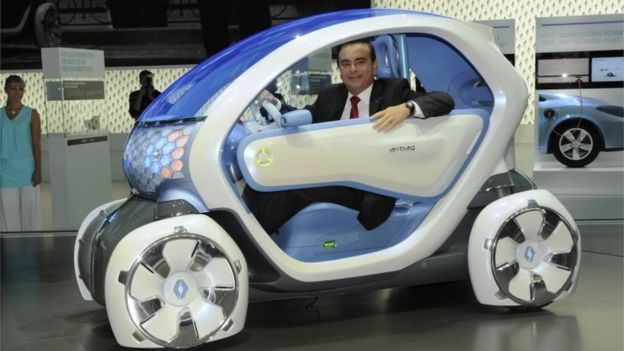
A lawyer for former Nissan chief Carlos Ghosn says he is "dumbfounded" by the news that his client has fled to Lebanon after jumping bail in Japan.
"We were completely caught by surprise," defence team head Junichiro Hironaka told reporters, adding that he had not spoken with Mr Ghosn.
On Tuesday, Nissan's ex-CEO, who was awaiting trial on financial misconduct charges, confirmed he had left Japan.
He said he had not fled justice but escaped "political persecution".
The 65-year-old was one of the most powerful figures in the global car industry until his arrest in November 2018.
He was born in Brazil to parents of Lebanese descent and was raised in Beirut, before travelling to France for further education.
The French and Lebanese foreign ministries say they have no knowledge of the circumstances of Mr Ghosn's departure from Japan and subsequent arrival in Lebanon.
Lebanese media has said he flew in on a private jet in via Turkey.
What did his lawyer say?
"I am dumbfounded," Mr Hironaka told reporters later on Tuesday. "I don't even know if we can contact him. I don't know how we will proceed beyond that."
He added that his legal team was still in possession of his passports.
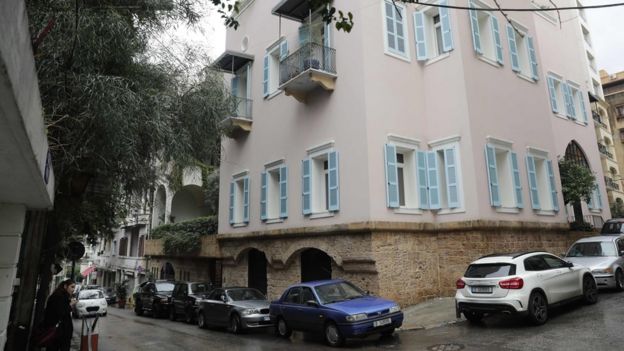
Image copyrightAFPImage captionThis house in Beirut belongs to Mr Ghosn. His wife, Carole, was born in the city
Mr Ghosn was released on $9m bail in April under strict conditions that barred him from travelling abroad.
How he could have left Japan remains unclear. It is not known whether he was holding duplicate passports - as some businesspeople are sometimes allowed to do.
There was video surveillance of his home, and he had restricted phone and computer usage.
What did Carlos Ghosn say?
Mr Ghosn released a statement after news agencies on Monday reported he had travelled to Lebanon.
Confirming he had gone to the Middle Eastern country, Mr Ghosn said he would "no longer be held hostage by a rigged Japanese justice system where guilt is presumed, discrimination is rampant, and basic human rights are denied.
"I have not fled justice - I have escaped injustice and political persecution."
Big in Lebanon
Analysis by Quentin Sommerville, BBC News, Beirut
The former Nissan boss will have no trouble finding somewhere safe and luxurious to stay in Lebanon. Of Lebanese heritage, Mr Ghosn spent his early years here with family members. He's much celebrated and even appears on one of the country's postage stamps.
Image copyrightLIBANPOST
He is also the co-founder of the IXSIR vineyard here, which boasts wines that are rich and "of remarkable elegance".
Escaping Japan would have been difficult given that his three passports were taken from him, but Lebanon has less than stringent border controls. Mr Ghosn is said to have arrived by private jet on Sunday evening and someone of his stature would have been able to breeze through immigration. When in town, he is often escorted by the security services.
He's been held in Japan for more than a year and in that time Lebanon has changed dramatically. Months of protests against corruption and the political elite have ousted the prime minister, and there's a full-blown economic crisis.
Japan gives millions in aid to Lebanon and will want Mr Ghosn returned. He may have successfully fled Japan, but he hasn't escaped his troubles.
What charges does Carlos Ghosn face?
Once considered a hero in Japan for turning around Nissan - even becoming the subject of a Japanese comic book - Mr Ghosn spent 108 days in custody after his arrest in Tokyo in November 2018.
Japan's criminal justice system and how much crime actually goes on in Japan is a joke. Japan's domestic crime-rate is PHONY AS SHIT!
Rape is rampant and UNREPORTED.
Carlos Ghosn and Japan's 'hostage justice' system
Carlos Ghosn, Nissan's fugitive ex-chairman, says he has not fled justice but "escaped injustice and political persecution".
His hasty departure for Lebanon has once again turned the spotlight on what has been described as Japan's "hostage justice" system.
It is a term few outside Japan will have heard of until now, but what does it mean?
Living in Japan, it's easy to become complacent about crime - there is so little of it. Japan's incredibly low crime rate is often attributed to a homogeneous culture, small income gap and full employment, but it's also true to say that many people are just terrified of being arrested.
I got my first inkling of why in 2014 when an artist I knew, Megumi Igarashi, was arrested for distributing "obscene material". Igarashi had made a digital scan of her own genitals and used that model to make items such as key fobs and a large yellow kayak.
Most people thought it hilarious and she was dubbed the "vagina artist". But Tokyo prosecutors were not amused. They held her incommunicado for three weeks.
"Why on Earth would they hold her for three weeks over something so silly?" I asked a friend.
"Because they can," she responded.
Image copyrightAFPImage captionMs Igarashi's case caused a sensation in Japan which has strict obscenity laws
In Britain, only terror suspects can be held without charge for 14 days - and that is controversial. In Japan, a shoplifter can be held for 23 days.
The pressure to confess
"The Japanese criminal justice system is focused on interrogation. The aim is getting a confession," explains Nobuo Gohara, who spent 23 years in the prosecutor's office before resigning. He now works in private practice and campaigns for reform of Japan's justice system.
"A suspect who admits to the crime is released from imprisonment," Mr Gohara tells me. "But if a person refuses to admit to a crime, the prosecutor's office will strongly oppose release until the suspect makes a confession."
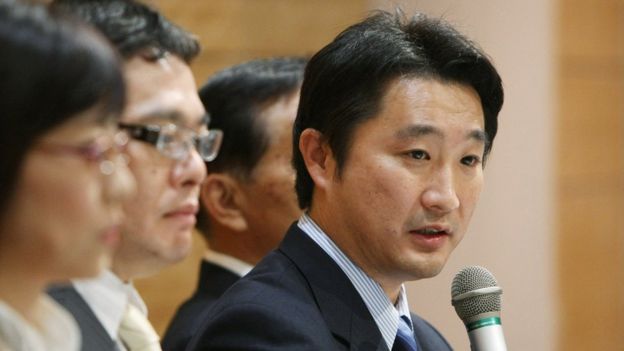
That is what happened to Tomohiro Ishikawa. In 2010, the then sitting MP was arrested and accused of taking bribes. For three weeks, he was held in a tiny unheated cell. Each day, he was interrogated for 12 hours without a lawyer present. He eventually admitted to a lesser offence and nearly 10 years later, he is still bitter.
Image copyrightAFPImage captionTomohiro Ishikawa was held three weeks in a tiny cell. He later admitted to a lesser offence.
"Japanese prosecutors are very persistent," he told me. "They write the plot out before they make the arrest."
"Then they force you to confess according to their storyline. In my interrogation, they didn't write down what I had said. [Instead] they would show me what they had prepared beforehand, then demand I sign it. Many times, I told them I would not sign, because it [the statement] was not what I had said."
"Sometimes they shouted at me," he said. "At one point the deputy chief prosecutor started crying, asking me why was I lying."
This pressure to confess is even more worrying given that 89% of criminal convictions in Japan are based partly or wholly on confessions.
There are numerous examples of people spending years in prison for crimes they didn't commit or where serious doubts have emerged because of apparently "unsafe" confessions.
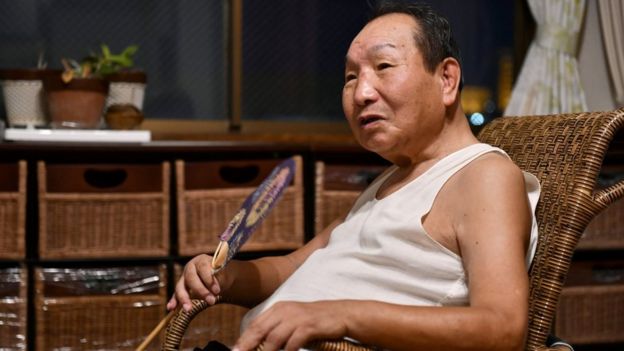
Image copyrightAFPImage captionIwao Hakamada is still fighting to clear his name
A former professional boxer named Iwao Hakamada was sentenced to death for murder in 1968. His conviction was based on a confession he made under prolonged interrogation and later withdrew.
In 2014, after 46 years on death row, Mr Hakamada was released because his sentence was considered unsafe and there was no evidence to support the confession. At 82, he is still fighting to clear his name as he awaits a possible retrial.
The power of prosecutors
According to Mr Gohara, the root of the problem is the enormous power of prosecutors.
"Under Japanese law, the prosecutor's office has the exclusive right to indict. They also have the right to drop charges. This means that the prosecutor's office is very powerful in the Japanese criminal justice system. On top of that, in most cases, the courts follow the prosecutor's decisions."
In a recent editorial in the Japan Times, Doshisha University law professor Colin Jones described the extraordinary position senior prosecutors hold.
"While the top official at the Justice Ministry is ostensibly the administrative vice-minister, in reality, he is inferior both in terms of seniority and pay grade to the prosecutor general and several other top prosecutors and, unlike most other senior bureaucrats, their uppermost ranks are appointed through a process that involves attestation by the Emperor," he said.
This is the system the accused, like Carlos Ghosn, find themselves up against, where if you don't confess, you will be held longer and more serious charges will probably be laid against you. If prosecutors do file charges, your chances of being found guilty stand at 99%.
Image copyrightEPAImage captionThe former tycoon says he is being treated as guilty before he can prove his innocence
"Officially, there is presumption of innocence," says Mr Gohara. "But even if the suspect is not guilty, there is an advantage for them to admit to the crime. This is the most evil effect of Japan's hostage justice system."
After the first 23 days of detention, the ordeal is not necessarily over. Prosecutors are permitted to re-arrest a suspect on a slightly different accusation, with approval from the courts. The clock is then reset and another 20 days of interrogation begin.
This is what happened to Carlos Ghosn, twice. In all, he was held in interrogation for 53 days before being formally indicted.
No bail for Ghosn
In many countries, formal indictment would be the trigger for a suspect to be released on bail. But again, not in Japan - as Carlos Ghosn has found out.
Ms Meng is the chief financial officer of Chinese telecom giant Huawei. She is wanted in the US, accused of conspiring to breach international sanctions against Iran.
Ten days after her arrest, on 11 December, Ms Meng was released on bail of 10 million Canadian dollars. She is now staying in one of her two Vancouver homes, and is obliged to wear an electronic ankle tag.
Image copyrightEPAImage captionHuawei's Meng Wanzhou merely has to wear an electronic ankle tag
Defenders of Japan's system deny that confessions are behind the 99.9% conviction rate. They say it is because Japanese prosecutors indict at a much lower rate than in the US. In other words, they only indict when they are sure they can win. In 2015, the prosecution rate was 33.4%, official figures show.
The gatekeepers of justice
But Carlos Ghosn's case raises questions. Several lawyers have told me the case against him looks weak. In an editorial in the Nikkei newspaper, corporate lawyer Stephen Givens describes the case against him as "thin soup".
"By any objective measure, the misconduct alleged was less serious than the corporate misfeasance that is routinely overlooked in Japan," he writes. "Nothing we know that [Mr] Ghosn allegedly did smells like a serious crime deserving prison."
So why did the special investigation unit of the Tokyo prosecutor's office pursue this case so hard? Mr Ishikawa believes Mr Ghosn's real crime, in the eyes of Japan's prosecutorial elite, is greed. He was the first chief executive in Japan to earn millions of dollars a year, and that changed Japanese corporate culture.
"The Tokyo prosecutor's office… is driven by their belief that they are the gatekeepers of justice. In an era of economic inequality, they want to make their name as the ones who nailed the rich."
Mr Ghosn's decision to flee may well have been influenced by another aspect of Japan's justice system - there is no double jeopardy.
Even if he had been found innocent of the charges against him, the prosecutor's office could have simply appealed to the high court to have that verdict overturned. It is, say critics, one more reason so many Japanese criminal suspects confess.
This article is a prime-example of how Non-Blacks DO NOT ALLOW THEIR ICONS TO GET RAILROADED BY OUTSIDERS!
It also highlights why Japan is on course for Extinction within Our Lifetime.
They wanted to cancel a deal with a foreign-based company and instead of just steppin up and taking whatever L they were gonna take!?
They decided to try to DODGE THAT and TAKE DOWN THE FOREIGNER TIED TO THE DEAL SO THEY THEMSELVES WOULDN'T LOOK BAD!
Now!?
I can BET YOU MONEY that Carlos Ghosn was probably DOING SOMETHING ILLEGAL AND/OR ILLICIT BUT IT WASN'T TIED TO THIS DEAL!!!!!
Here is the Article;
Carlos Ghosn: How did the Nissan ex-boss flee from Japan?
He was once a titan of the car industry who held hero status in Japan. He then became one of the country's most well-known criminal suspects. Now he's an international fugitive.
Carlos Ghosn, the multi-millionaire former boss of Nissan, spent months preparing to stand trial on financial misconduct charges. At least, that was what the Japanese authorities were led to believe.
He posted 1bn yen (£6.8m; $8.9m) in bail in April. He was monitored by a 24-hour camera installed outside his house. His use of technology was heavily restricted and he was banned from travelling abroad.
Then, in a move that left Japan red-faced and his own legal team baffled, he appeared in Lebanon on New Year's Eve. "I have escaped injustice and political persecution," he declared in a statement.
"We were completely caught by surprise. I am dumbfounded," his lawyer, Junichiro Hironaka, told a crowd of reporters in Tokyo shortly after learning of Mr Ghosn's flight. "I want to ask him, 'How could you do this to us?'"
Another pressing question is: how did he do it at all?
A musical escape?
One Lebanese TV channel - MTV - reported that Mr Ghosn had fled his court-approved residence in Tokyo with the assistance of a paramilitary group who were disguised amongst a band of musicians.
It said the band had performed at his house and, shortly after they had finished, the 65-year-old hid in a large musical instrument case which was then hurried to a local airport. If this really happened, it may have been a tight squeeze even for Mr Ghosn, whose height is reported at 5ft 6in (167cm).
According to the MTV story, he then flew to Turkey, before arriving in Lebanon on a private jet. The broadcaster provided no proof for this theory which, unsurprisingly, spread rapidly across social media.
Mr Ghosn's wife, Carole, however, told Reuters news agency that reports of the musical escape were "fiction". She declined to provide details of how her husband did escape the country.
Donning a spy-movie disguise is not beyond Mr Ghosn. In March, in a bid to throw journalists off his scent, he left prison disguised as a construction worker. He was quickly identified, mocked in the media, and his lawyer soon apologised for the "amateur plan".
The role of Carole Ghosn
The former CEO's getaway from Tokyo to Beirut was meticulously planned over a period of several weeks or months, according to media reports.
The Wall Street Journal, which cited a number of unidentified sources, said a team was carefully assembled to carry out the plot. The group reportedly included accomplices in Japan who transported Mr Ghosn from his house and onto a private jet bound for Istanbul. From there, he continued his journey to Beirut where he arrived in the early hours of 30 December.
The plane tracking site FlightRadar24 showed a Bombardier Challenger private jet arriving at Beirut-Rafic Hariri international airport shortly after 04:00 local time. Mr Ghosn then met his wife Carole, who was born in the city and was heavily involved in the operation, the Wall Street Journal says.
Several media reports said private security operatives helped smuggle Mr Ghosn out of house arrest.
The former Nissan boss made his escape by flying out of Japan's Osaka airport on a private jet, the newspaper reported. It said Mr Ghosn was not required to wear any electronic tags while on bail.
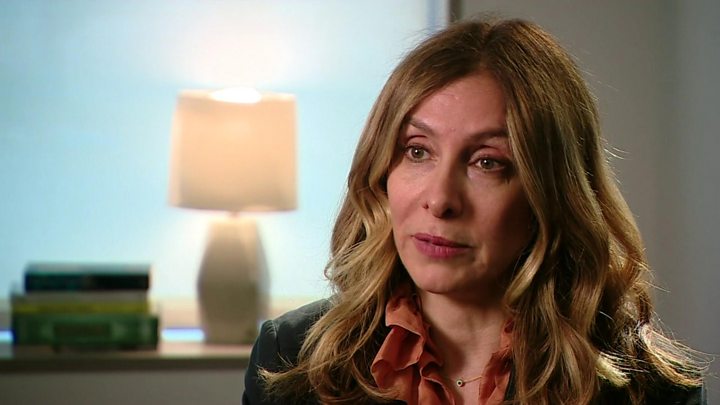
Several reports have said Carole Ghosn was a major figure behind the plan for her husband to skip bail and get out of Japan. She spoke with him for more than an hour on 24 December, Mr Ghosn's Japanese lawyer said. The couple had previously been banned from meeting or communicating under Mr Ghosn's bail conditions.
After her husband arrived in Lebanon, Mrs Ghosn told the Wall Street Journal that their reunion was "the best gift of my life". She has not commented on her alleged involvement in the operation.
Earlier this year she told the BBC: "I want my husband back. I want him with me. I know he is innocent."
Mr Ghosn has repeatedly denied any wrongdoing.
Three passports
Questions remain about the documents Mr Ghosn used to enter Lebanon. He holds three passports - Brazilian, French and Lebanese - but his legal team maintain that they were in possession of all of them when he left Japan.
It is not known whether Mr Ghosn was holding duplicate passports - as businesspeople are sometimes allowed to do. It has also been reported that he may have had a diplomatic passport issued by Lebanon although this has not been confirmed.
While the French newspaper Le Monde said he travelled on an ID card, others have reported that he may have used a French passport or even a false identity with forged documents.
A spokesperson for Mr Ghosn told the Financial Times he used a French passport to enter Lebanon but would not disclose how he had left Japan.
Ghadi Khoury, the Lebanese foreign ministry's director of political affairs, said the former Nissan boss entered the country on a French passport and Lebanese ID, according to the newspaper.
The embarrassment caused by Mr Ghosn's flight soon sparked a reaction from Japan. One Japanese politician asked whether he "had the support of some country". A former governor of Tokyo was more forthright, accusing Lebanon of direct involvement.
Mr Ghosn grew up in Lebanon, owns property there and is a popular figure. He even appeared on one of the country's postage stamps.
The two Reuters sources said the Lebanese ambassador to Japan had visited him every day while he was in detention. The ambassador has not publicly responded to this claim.
The Lebanese government has denied any involvement in Mr Ghosn's escape.
Mr Khoury told the Financial Times that Lebanon "had asked for [Mr Ghosn's] extradition", but said the government had not had any involvement in his plan to escape.
France and Turkey have also said they were unaware of Mr Ghosn's plan.
There is no extradition deal between Japan and Lebanon, which means the future of Mr Ghosn's trial is now fraught with uncertainty.
Japan gives millions in aid to Lebanon and will likely want Mr Ghosn returned. But it will no doubt have to answer further questions about how such a high-profile suspect was able to get out of the country in the first place.
Right now I am COLORING Mun-Da the Beastmaster, who is pictured above!
I've spent the entire day coloring and having to stop at various times to let the various colors set & dry. It's already 9:36pm EST so lemme get this post up along with the rest!

 AFP
AFP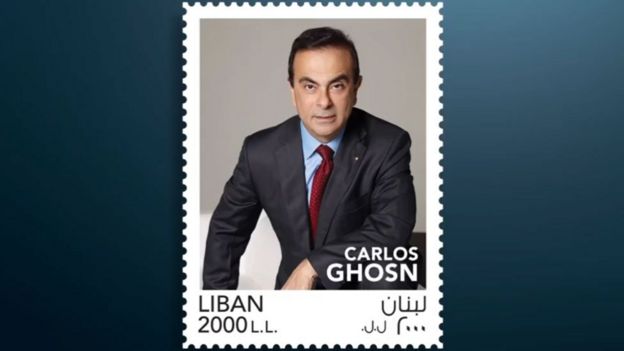 LIBANPOST